The Journal · Craft
Half canvas vs full canvas, and why it matters
Inside the front of a good jacket is a layer you will never see, and it shapes almost everything you do. What canvas is, how the main constructions differ, and why the most elaborate option is not automatically the right one.
6 min read
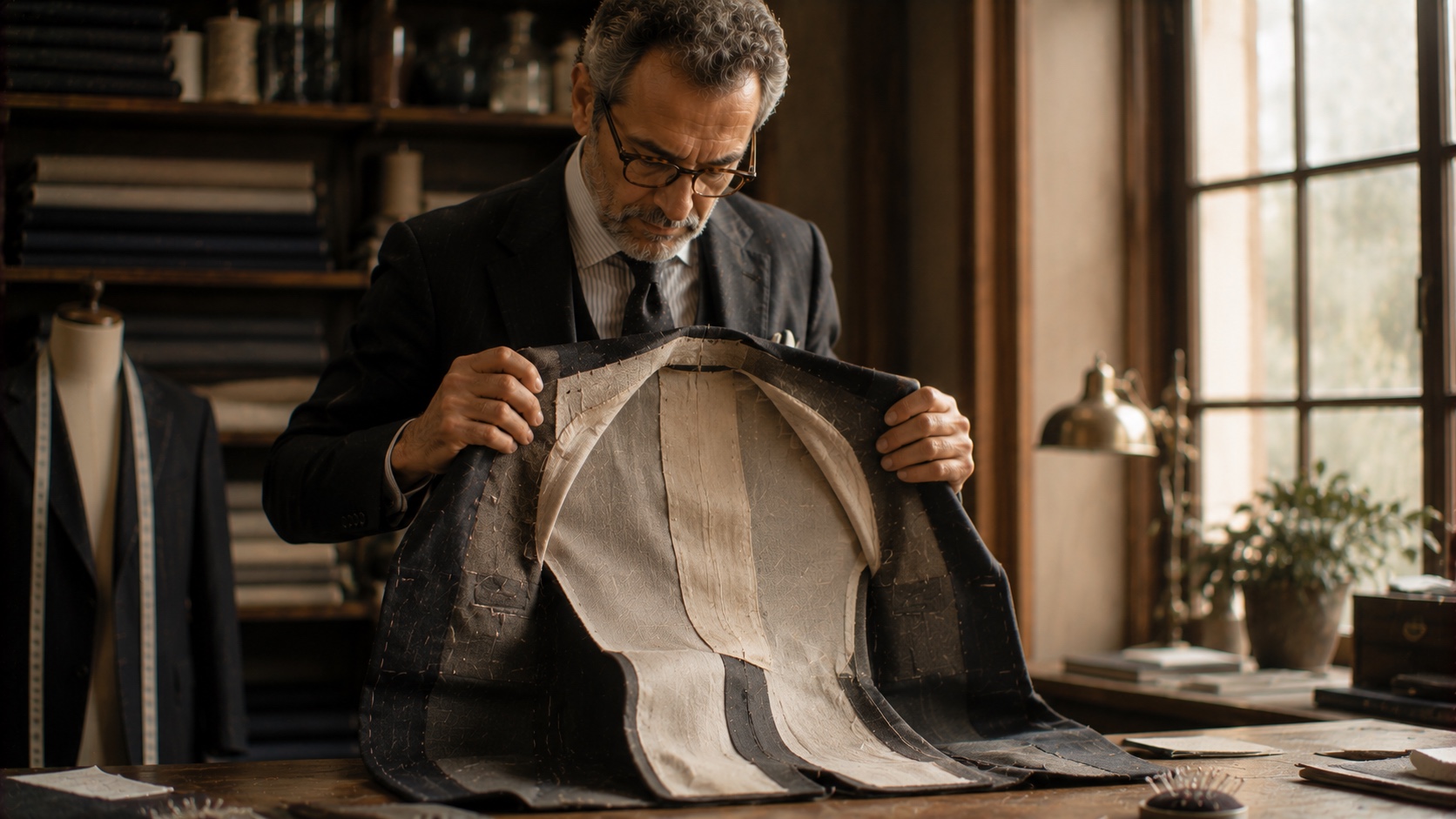
The layer that gives a jacket its shape
Cloth on its own is soft. Hang a length of suiting from your shoulders and it will fold and collapse wherever gravity takes it. What turns that cloth into a jacket with a chest, a clean front edge and a lapel that rolls rather than lies flat is an interlining sitting between the outer cloth and the lining. In tailoring, that interlining is called the canvas.
A traditional canvas is a woven material, typically a blend of wool or cotton with horsehair, which gives it a springy, resilient quality. It is usually supported by further layers over the chest, often a felt, that add a little more body where a jacket needs it most. How that canvas is attached to the cloth, and how far down the front it runs, is what the terms fused, half canvas and full canvas describe.
Fused construction
In a fused jacket, the structure comes from a lightweight interlining coated with an adhesive and bonded to the back of the front panels with heat and pressure. It is quick, consistent and inexpensive to produce, which is why most ready-to-wear jackets are made this way.
Modern fusing is far better than it once was, and a well-made fused jacket can look crisp on the hanger and in the first months of wear. Its limitations show over time. Glued cloth cannot move freely, so the front tends to feel flatter and stiffer, and the lapel is more likely to lie pressed rather than roll softly. In older or poorer fused garments, the bond can weaken after heat, moisture or repeated cleaning, leaving the outer cloth rippled where it has come away. Tailors call this bubbling, and it is difficult to repair.
Full canvas
A full canvas jacket takes the opposite approach. The canvas runs the whole length of the front, from the shoulder down to the hem, and it is not glued to the cloth. Instead it floats, held in place with stitching, so the cloth and the canvas can move together while keeping their own character.
The lapel of a canvassed jacket is shaped rather than simply pressed. In traditional bespoke tailoring this has been done with rows of very small padding stitches that coax the lapel and collar into a curve; today machines can carry out much of that work as well. The result is the soft, three-dimensional roll that people often notice without being able to name.
Because nothing is bonded, the cloth and the canvas can move independently and the front drapes more naturally. Over months of wear a full canvas tends to settle to the wearer, the chest taking on a gentle shape from the body underneath it. It is also the most involved construction to make, with more material, more steps and more skill, which is why it costs more.
Over months of wear a full canvas tends to settle to the wearer.
Half canvas
Half canvas sits between the two. A floating canvas runs through the chest and the lapels, where shape and drape matter most, and stops partway down the front. Below it, the lower front relies on a lighter fused interlining.
The balance is a sensible one. The lapel still rolls, the chest still has a natural, unglued shape, and because the chest and lapels are not fused, there is no bond there to fail and bubble. At the same time, the construction is less involved than a full canvas, which keeps the cost down. For many people and many suits, half canvas delivers most of what they would notice about a canvassed jacket.
Canvas is not the same as padding
It is easy to confuse canvas with structure in general, but they are separate decisions. Shoulder pads, or the absence of them, determine how square or natural the shoulder line looks. The canvas determines how the front of the jacket behaves. A jacket can have a soft, barely padded shoulder and a full canvas, or a strong, built-up shoulder over a fused front.
The weight of the canvas matters too. A heavy, springy canvas gives a jacket a firm, sculpted chest in the English tradition. A lighter canvas gives a softer front that still rolls and drapes, the character many people associate with relaxed Italian tailoring. Talking about half or full canvas without also thinking about the shoulder and the weight of the interlining only tells part of the story.
What you actually notice
The differences between constructions are real, but they are not always dramatic, and they depend a great deal on the cloth, the cut and the quality of the making. Broadly:
- Lapel roll. Canvassed lapels, half or full, roll in a soft curve. Fused lapels tend to lie flatter.
- Drape. A floating canvas lets the front move with you. Full canvas carries that quality down to the hem.
- Structure over time. A good canvas holds its shape through years of wear and gradually moulds to the wearer.
- Comfort. Less adhesive can make the front feel less stiff, but how warm or cool a jacket wears depends on the whole garment: the cloth, its weight and weave, the lining and the weight and coverage of the canvas.
- Weight. A full canvas adds some substance to the front, which some people like and others do not.
A simple way to feel the difference on a finished jacket is to pinch the cloth just below the buttonhole on the front. On a canvassed jacket you can often separate three distinct layers: the outer cloth, the canvas and the lining. On a fused front the cloth and interlining feel like one. It is not a perfect test, but it is a useful one.
Full canvas is not automatically the answer
It is easy to assume that the most elaborate construction is always the best purchase. For some suits it is. A heavier winter suit, a jacket with a pronounced chest and a strong lapel, or a suit you intend to wear for many years in a structured, traditional style will all benefit from a full canvas.
For others the case is weaker. A lightweight summer suit with a soft shoulder is meant to feel unstructured; a full canvas can be made light, but the gain over a half canvas is smaller there. A suit that will be worn occasionally may never wear long enough to show the difference between half and full canvas. And the budget spent on a full canvas might sometimes be better spent on a cloth that suits your climate or on a second suit to rotate with the first.
The sensible order of priorities is usually fit first, then cloth, then construction. A beautifully canvassed jacket in the wrong cloth or the wrong cut is still the wrong jacket. A half canvas jacket that fits well, in a cloth chosen for how you live, will serve most people very well.
Choosing
Think about how the suit will be worn, how much structure you like and how long you intend to keep it. If you want a soft, natural front at a sensible cost, half canvas is an excellent default. If you value the fullest drape, want a more structured silhouette or plan to wear the suit hard for many years, full canvas is worth considering. And if a jacket is fused, judge it for what it is: a practical construction that can look very good, but that will not age in quite the same way.
Canvas is invisible when a jacket is finished. Understanding it is one of the simplest ways to know what you are paying for.